

I had a discussion with my cofounder Joseph last week about how it's often more optimal to change the game you're playing than it is to try to become exceptional at a particular game, because inevitably, there will be some games that you’re just not naturally suited to. (This goes against the tendency in the U.S. to try to encourage your kids to do whatever they want to do, which I generally consider bad advice, by the way.)
Following that thread, the following statement shouldn’t be so controversial: if your primary objective is to be exceptional at something, you shouldn’t choose a game that you’re not good at.
(We ran through an analogy to video games that I thought was particularly poignant: if you’re born as a warrior, you don’t run around trying to cast spells. You’ll have a much better time if you learn to swing a sword. It’s all about person-game fit.)
So I’m going to talk about how I’ve been thinking about how to find/construct a game you could be world-class at. It’s nothing profound, and the punchline is simple, so I’ll just say it now: statistically-speaking, you can become a much rarer commodity if you find a domain that requires an intersection of multiple superpowers that you have.
The standard approach: find a thing you’re good at
Let’s talk about how we’re usually inclined to find excellence in ourselves: the standard approach is to generally just find something you’re good at. If you’re good at something, after all, you’ll have a stable career, stable job, and can anticipate some steady level of progression. If you’re exceptional, you might even find yourself rising to some level of seniority. If you’re world class, you’ll get to the very top, but it’s a very binary outcome — you either have some genetic predisposition to that level of excellence or you don’t. If that’s your goal, there’s no amount of hard work that’ll close that natural talent gap.
This is a very reasonable way to live, of course. Find what you’re good at, and live a rewarding, fiscally-stable life. If you’re lucky, you’ll be one of the few people that can be truly exceptional in your domain. But I want to offer a different way of thinking about this whole endeavor so that you might find something you are truly world class at.
The rigorous approach: fundamental skills and intersections
I think we tend to view exceptionalism as tied to particular professions, but these are just composites of more fundamental latent factors — skills, propensities. What makes you a 1% PM, for instance, could be broken down into a multitude of things you are good at or bad at: your raw intelligence and superhuman empathy, perhaps. One of the most useful things you could do, then, is to figure out which of those latent skills are your superpowers. What makes you excellent at a particular endeavor?
The goal, then, is to find a domain where your particular set of skills and liabilities are optimal. If you’re 90th percentile at 3 things and those three things are critical for success in a particular profession, you’re suddenly 99.9th percentile1.
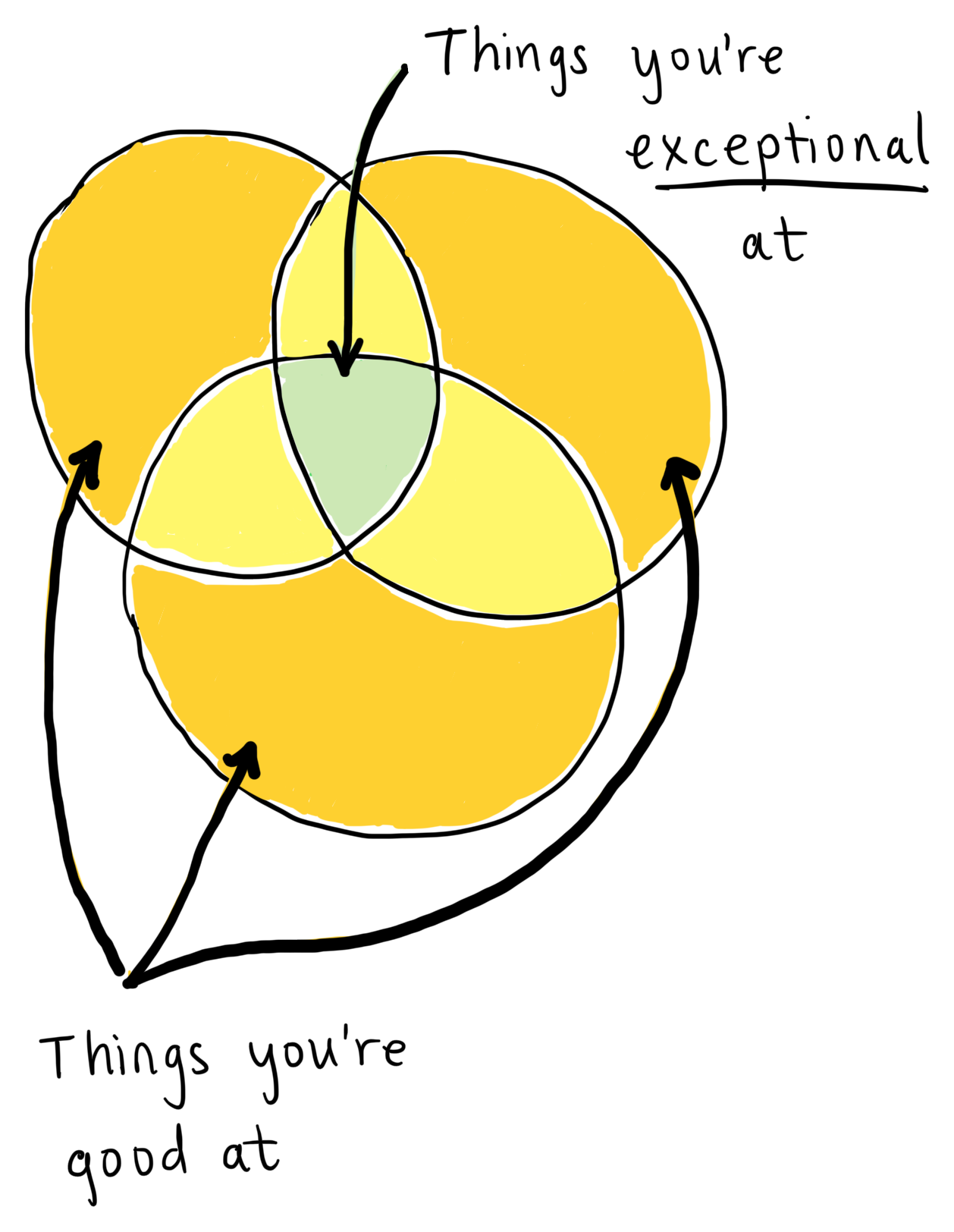
Of course, this is not to suggest some sweeping career shift (though, of course, that’s possible). I think a lot of folks would benefit from reflecting on this sort of thing when making even more seemingly inconsequential career decisions — should I be in industry X or Y? Should I go the IC or manager route? Should I be more technical or more high-level? If you know what makes people in these roles exceptional, and if you know your own superpowers, you’ll have a much easier time making these sorts of decisions.
Final comments
A few final points:
It’s hard to give things up, particularly when you’ve spent a lot of time on an endeavor. But this is why thinking about the latent skills has been so helpful — you can quantify what you’ve gotten out of the experience.
This is all later-stage career advice, not early-stage career advice. You can’t know what you’re good at without trying something, so some level of error early on is necessary.
Having a variety of different skills can be quite helpful in forming strong analogies in other disciplines, so it’s generally not so productive to worry about hitting the mark on your first try.
This is all about finding something you can be world-class at, but says nothing about finding something you enjoy. But that’s a discussion for another time.
Of course, assuming these are independent variables.
I like this. I would add that I think it's a process of iteration and not as categorical as it might seem on the surface. We live in a world of categories, and yet the most interesting and happy people seem to be the ones that embrace their categorical overlap — the ones that defy simple categorization because it makes the most sense to them.
So, I would say the bigger indicator of long-term success is how well can you move towards the hidden games that you are better and better at, until you arrive at one that only you can play. I'm sure it's possible to keep iterating from there, as well, even if it isn't necessary for happiness.
Is there a set of skills taxonomy?