

I’ve been watching myself think lately, and I’ve noticed that there are some interesting things that happen before what I usually label “thinking”.
Word-thoughts
Some of my thoughts are simple, starting as plain words. Of course many thoughts involve words, but some thoughts are words at their very inception. These word-first thoughts are strange, because it feels as though there’s no precursor — it doesn’t even feel as though I’m the one saying them. They’re like a precomputed cache: the words come, then my proper, willed thought condenses from the momentum of those words passing signal through my brain. They’re automatic, detached and dissociated from the process typically responsible for what I consider “thought”. Somehow, these words feel cheap or fake, as if my thinking brain did not sanction them.

I imagine this must be the closest thing to what AI does with its token prediction. By starting with some words, more words just keep flowing out. I find this to be a wonderful utility when I’m stuck, but the process does feel a lot like talking with AI. It widens the aperture of thought through some sort of Bayesian word association, and that can often allow me to hop-skip to a better minima in my brain’s gradient descent. That said, rarely does it lead to any novel, fundamental understanding on its own. If I’m stuck on something conceptual (e.g. why a system behaves the way it does), this pattern of thought can point me in a direction I hadn’t before considered, but it almost always fails in delivering the correct, novel synthesis I’m looking for. I generally can’t calculate in words, for the structure is still nebulous and resists the premature compression that words require.
Still, they do often act as a springboard from which synthesis and, thereby, better words come.
Proto-thoughts
On the other side of word-thoughts: sometimes my brain starts with this mixed feeling-cognitive signature. Proto-thoughts, I like to call them — patterns that feel like shapes floating in neurological mist. These aren't visual shapes exactly, but rather the feeling of a concept's contours — a vague form that exists only because my brain is somehow holding it in position. I like to think of proto-thought in opposition to what we generally think of as thoughts: word-thought and image-thought. And a useful analogy to me in this regard has been likening each to phases of matter. Proto-thoughts are gaseous, naturally expanding and contracting, reforming and ramifying more than their more concrete counterparts. But when they condense, they become the more solid images and words we traditionally recognize as thoughts.
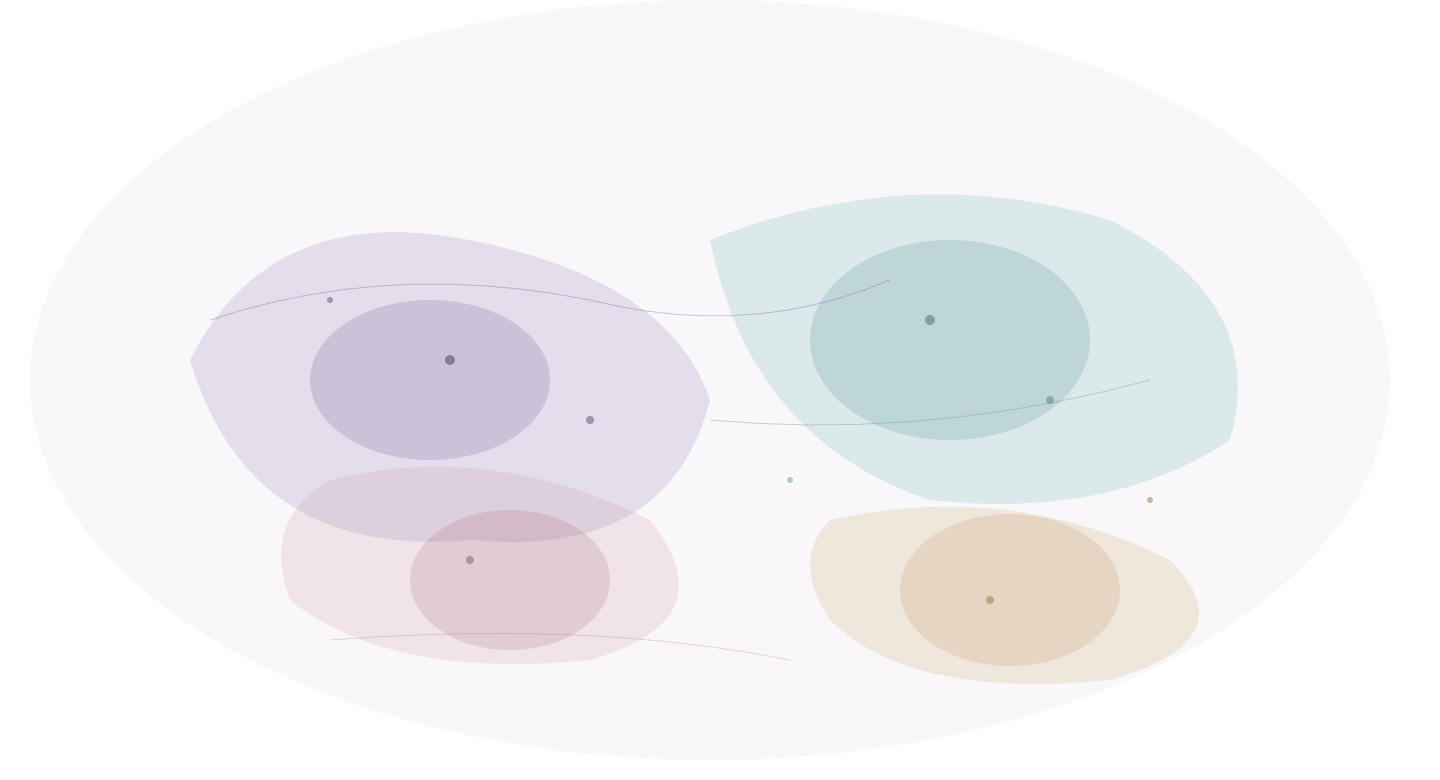
I started to notice this first while meditating: in the stillness of meditation, I noticed a consistent, distinct neurological buzz of something happening before my mind goes berzerk. A tightness in my scalp, a bubbling between my ears. But it’s not the physiological changes here that matter. It’s that these things seem to be acting as physical extensions of my brain by helping it hold part of the nascent proto-thought (or at least, this is how it feels).
This might sound arcane, and if it does, I’d encourage you to just sit and try to look for these proto-thoughts. It’s the goop that your brain is before the concept / words / image appears. Assuming brain chemistries are diverse, I imagine this might not even be relatable to some of you, but nonetheless, I want to spend some time sharing some of the observations I’ve had about proto-thoughts. I’ve found a lot of value I’ve found in scrutinizing my own experience, and I hope this can offer a useful starting point for your own introspection.
Characterizing proto-thought
I’ve noticed that proto-thoughts have a few important properties. Consistent with my previous gaseous phase metaphor, proto-thoughts seem to exist in the same phase as emotions (which also feel gaseous), and so I find that they’re blown around easily by them. I’ll have a proto-thought about how to solve a problem, but jealousy or hubris can easily blow the thought into a different, less optimal shape. To me, this process is so automatic, so reflexive, and, tautologically, so non-verbal that it took me a long time to even recognize it was even happening as a distinct phase outside of images or words.
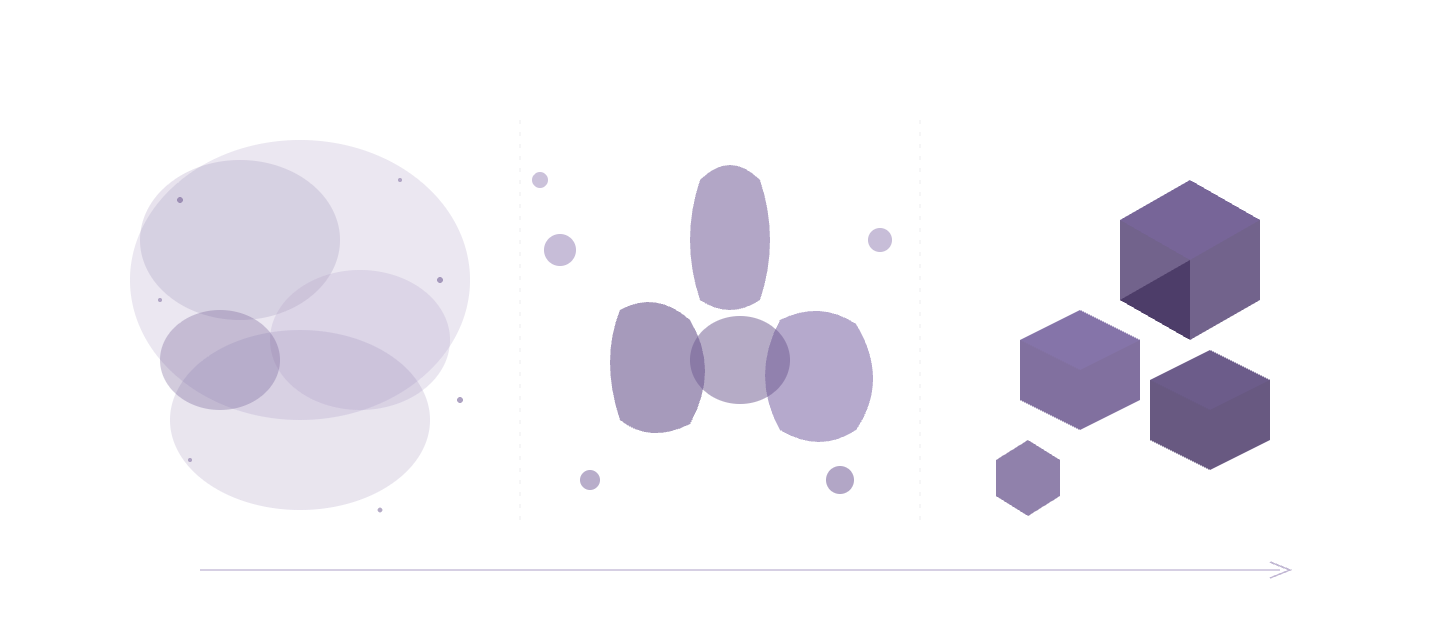
The danger of being so close to emotion is that I’ve found that they tend to be subject to the same kind of neural etching that happens when emotional responses are conditioned within you. I.e. for decades, my brain has repeatedly had the same response to particular emotions. Anger → angry. Impatience → impatient. Lust → horny.1 But proto-thoughts adhere to emotions easily, and so become subject to the same conditioning patterns. For instance, when I’m in the throes of road rage, I’ve noticed that I’ll often have the same proto-thoughts — not word-thoughts, but just a positioning of my brain that invokes a sentiment I’d had before. Perhaps once I said, “wow that person must be an idiot”, and suddenly whenever I have road rage, the same neurons fire, holding the vector of that idea in my head. No words, just the same exact proto-thought.
I have a working theory that proto-thoughts act as a sort of default mode cache. This metaphor conveniently captures a few properties of proto-thoughts: first, as a cache, proto-thoughts are extremely fast. I’ve found that computations in proto-thought space happens an ~order of magnitude faster than they do in word-space. When leveraged in this way, it might be appropriate to simply label proto-thoughts as “intuition”, but this would be a misnomer. Secondly, as a cache, it can be rewritten/retrained. A common bit of layman’s advice I’ve heard given is that “you are not your thoughts”, and so once thought, you need not engage with them or judge yourself for having them. That said, I’ve found that it’s possible to stop myself from particular thoughts at the proto-thought stage. This is particularly useful for patterns of thought that I’m trying to avoid — those attached to emotions that do not adhere to my internal sense of virtue2. Finally, this is all particularly useful because there is some intimate tie between proto-thoughts and default mode. I haven’t yet identified what the stew of proto-thoughts, emotions, and word-thoughts is that comprises default mode, but I’m quite sure that default mode leverages your proto-thoughts a lot, so much so that it feels as though mastery of proto-thought space is tantamount to mastery of default mode.
On proto-thoughts and mindfulness
Simply giving a name to proto-thoughts has been interesting for my mindfulness practice. Instead of the standard cycle of noticing I’m lost in thought and then bringing myself back, I’ve found that I can instead intercept thoughts at the very moment they first emerge. I.e. before they can crystallize into the concrete ruminations that hijack my attention.

And I’ve found this produces a different quality of awareness that seems to exist almost outside of where my usual mindfulness meditation situates me. Because you're not managing thoughts after they've formed — you're witnessing the very process of their formation — you can remain unmoved in a way that hasn’t felt accessible to me before. It all finally feels less like herding cows and more like watching clouds, if that makes sense.
On proto-thoughts and reasoning
That said, a downfall of proto-thought I’ve discovered is that, without both intention and structured understanding, it can be inaccurate. It’s the part of your brain that fails brain teasers, succumbs to fun logical fallacies, why you can never find your keys. I believe proto-thought was my default mode of thought when solving all math/physics problems until I hit graduate school — I’d basically go through this flywheel of learning a little bit, then forcing myself to proto-think until I solved a problem. This meant I could solve the problems I could solve blazingly quickly, but I’d often be wrong/unable to do the work when I was missing the requisite knowledge. And this system of brain wasn’t so horrendous at unblocking itself. I imagine it is exceptionalism in proto-thought calculation that makes exceptional physicists and mathematicians, but without overcoming its limitations, produces the strange inconsistencies we often see in the brilliant.
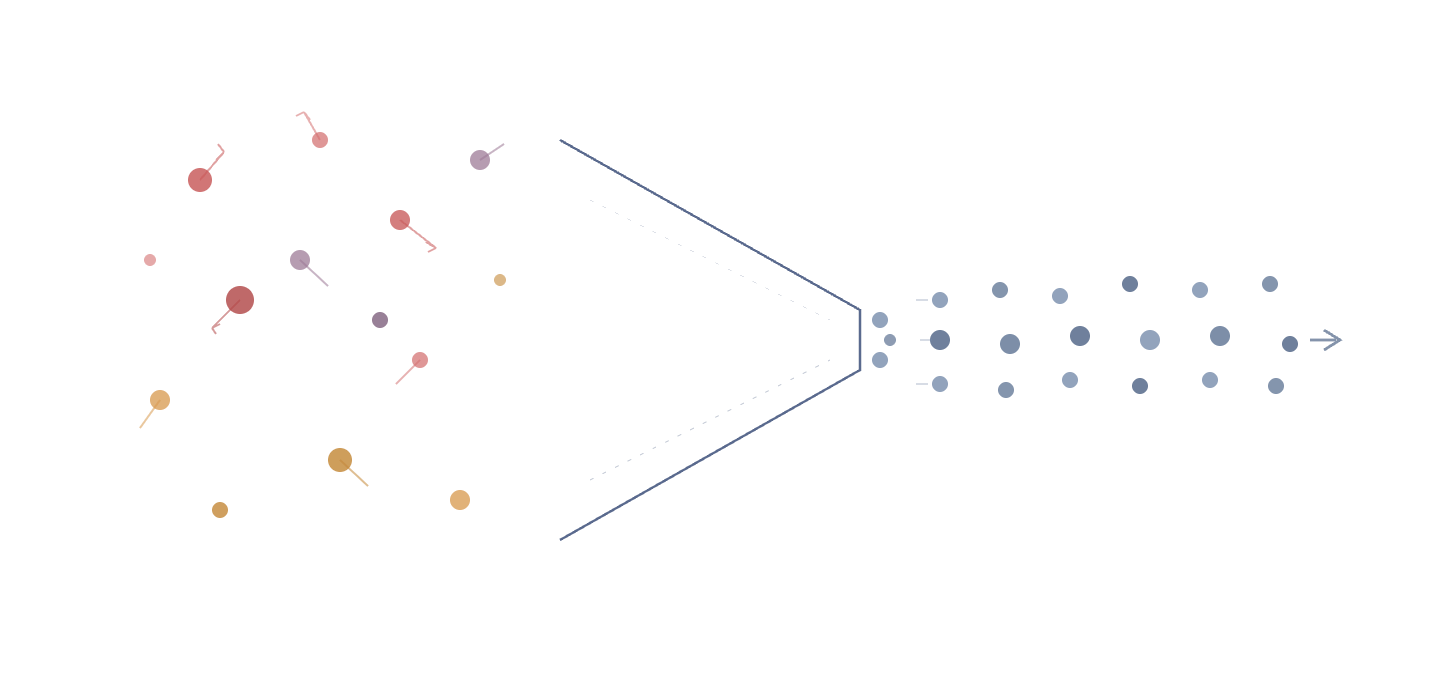
It took me a long time to start injecting deliberate self-reflection into this process to figure out why I wasn’t able to solve a problem. Proto-thoughts can easily manifest as this sort of ambient cognition that’s steered by whatever feeling-tones happen to be present. Alone, these feeling-proto-thought mixtures are usually unintentionally conjured and, in my opinion, largely problematic — they're where bias, reactivity, and emotional distortion tend to condense into agency.
Intention acts like a boundary that channels one’s cognitive energy toward solving problems or generating insights. But without that intentional container, background proto-thoughts drift randomly, accumulating noise and bias. The clearest manifestation of this for me has been while driving — I feel the rising of frustration → haughtiness → a proto-thought assessment of the situation anchored on these feeling-tones. And then suddenly I’m muttering about idiots and maniacs.
Final thoughts
To be clear, most of this is N=1 observation, and it’s all inevitably biased/oversimplified by the frame that I’ve put over it. I’ve spent a lot of time proto-thinking about proto-thoughts, which, one the one hand feels wonderfully poetic, like building the rust compiler in rust. But other times, it feels a bit like using a ruler to try to measure itself.
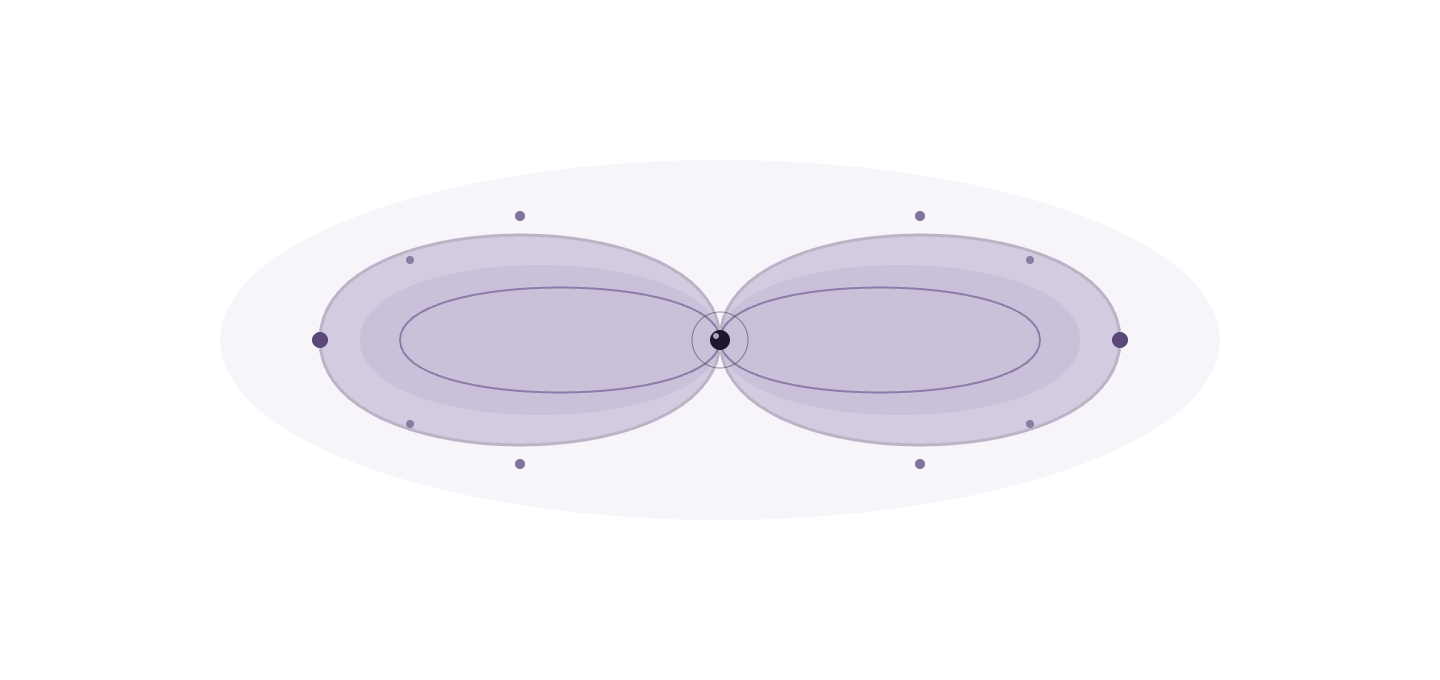
But still, I speculate that this is all generally entirely in one's control. It’s possible to recognize emotional states and bifurcate one’s proto-thoughts from those states. To some extent, this enables strictly purer thinking, which will improve all usage of proto-thought space. But, on the other hand, there are no free lunch problems. For instance, the conversion from pattern to words or images is one of practice. If you just think more slowly, more methodically, you can think in words instead. It’s just that it, unfortunately, can hinder the speed at which you can compute (or even limit your top computational ability altogether). On the other hand, it will improve your ability to articulate, and perhaps establish a stronger framework over which to proto-think your next proto-thought. There is certainly an optimal algorithm leveraging proto-thoughts that allows one to optimally get to the solution of a particular problem. But I’ll share that once I figure it out.
It’s already difficult to reflect on something you said and realize it was drenched in emotional bias. It’s even harder to stop yourself before the emotions take control. But even beyond that you can stop the proto-thought before it pulls forth the emotional state. Unless I’m actively thinking about mindfulness, I almost always fail at this.
I’m not a virtue ethicist but adhering to some set of naturally evolving set of principles has become how I try to live my life.
Your invitation to look for proto-thoughts is a good one. Some people notice them far more than others, and for some they're vivid enough to work with. I've been calling the sense behind them thoughtfeel: a sense for concepts that takes in an idea and its properties before it becomes words or pictures, the way vision takes in a scene. People who have it can hold a proto-thought steady, pay attention to it, and notice more detail the longer they attend.
A few of us compare notes and share techniques for learning with thoughtfeel at reddit.com/r/ThoughtFeel, and there's a 1-minute test at thoughtfeel.net. Thanks for writing this up.
Ted